What are you looking for?
 author
Choosing crimp contacts starts with a combination, not an isolated part number. The wire must suit the barrel, the tooling must form the intended crimp, and the terminated contact must still fit its housing and mating interface. A wire that slides into the barrel has passed an insertion check; it has not yet demonstrated a suitable termination.
For a custom part, resolve these interfaces before treating a drawing as ready for production. JC’s crimp contact products provide examples of contact forms, but a project enquiry needs the actual wire specification, barrel requirements and proposed tooling. The questions below help define that combination without borrowing settings from an unrelated terminal.
Provide the wire manufacturer’s designation and datasheet, together with conductor size, material, strand construction and any strand coating. Two wires with the same nominal size can differ in construction, so a size label alone is an incomplete description of the wire entering the barrel.
For procurement, the practical question is whether the quoted contact is being reviewed against a specific wire or an assumed wire range. List any approved alternatives separately. If the cable source is not yet fixed, mark that decision as open rather than allowing the first sample wire to become an undocumented production choice.
The conductor and insulation serve different roles in the termination. Give the insulation material and outside-diameter range as well as the conductor details. Where the contact includes an insulation support, its geometry needs to be considered separately from the conductor crimp. Where it does not, describe how the assembly will support the cable.
Also identify any seal, rear housing or cable-entry feature that the wire must pass through. A conductor may fit the contact while the insulation does not fit another part of the connector. Treat these as connected drawing checks, rather than assuming that a stated wire size resolves the complete assembly.
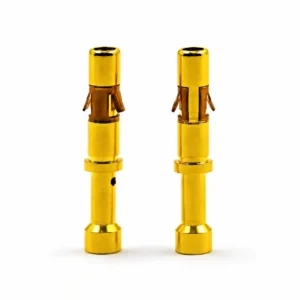
State whether the design uses an open barrel, a closed barrel or another documented construction. For a machined closed barrel, the drawing review may include the bore, usable depth, wall section and wire-entry transition. These describe different aspects of the geometry; a bore diameter by itself does not define the crimping arrangement.
Ask which dimensions apply to the finished, plated contact and which belong to the manufacturing process. Discuss the proposed features with the CNC turning team, including the surfaces that locate the part in the tooling. The enquiry should identify what the geometry must achieve, while leaving unconfirmed manufacturing details open for review.
Strip length needs to match the intended conductor position, not merely the visible depth of a hole in a photograph. Ask where the conductor end and insulation edge should sit before and after crimping. Where an inspection opening is provided, establish what it is intended to show.
Use the applicable contact and tooling instructions to set the actual dimensions. Too little preparation can leave insulation where conductor engagement is required; excessive exposed conductor may conflict with the surrounding assembly. The drawing and work instruction should give an operator a defined position to reproduce, rather than an instruction such as “insert fully” without a clear reference.
Record the tool model together with the die, locator, positioner or applicator used, as applicable. Include the relevant setup instruction and revision. Knowing the handle or press model is not enough if the interchangeable parts determine how the contact is located and formed.
Ask the tooling supplier which contact-and-wire combination the proposed setup covers. A tool’s general wire-size range does not establish compatibility with every custom barrel in that range. If existing tooling is a project constraint, provide its documentation at the start of contact design, rather than after the first sample batch has been made.
The contact must be located so the tool acts on the intended crimp area. Review how the part is supported, where it stops and how the wire is presented. A shoulder or retention feature that works in the connector may obstruct a locator or prevent the jaws from approaching the barrel.
Consider the sequence as well. Clarify whether a seal or rear accessory must be loaded onto the wire before termination, and whether the finished contact can be inserted into the housing afterward. These are inexpensive questions to settle on an assembly drawing and costly ones to discover after tooling or samples are committed.
| Review item | Information to exchange | Question to close |
| Wire | Designation, conductor construction and insulation dimensions | Which actual wire is covered? |
| Barrel | Finished geometry and intended conductor position | Where will the wire sit and the tool act? |
| Tooling | Tool, die and locating components with setup instructions | Is the proposed combination supported? |
| Connector | Housing, retention and mating drawings | Will the terminated contact assemble and mate? |
| Supply scope | Loose contacts or terminated samples | Who provides the wire and performs the crimp? |
A barrel modification should be checked against the rest of the contact. Identify the dimensions governing insertion into the housing, retention and engagement with the opposing contact. The pin and socket range shows several configurations, but similar-looking parts are not automatically interchangeable.
If only the wire end may change, state that boundary on the drawing. If the housing or mating part can also change, identify who controls those interfaces. This prevents a barrel proposal from being accepted before its effect on the completed connector has been considered.
Ask for the proposed base material and finish to be identified on the part specification. Separate requirements for different areas where necessary. Colour alone does not establish a coating specification, and a material listed in a company catalogue is not automatically the material used for every contact.
JC’s catalogue describes custom connector contacts and lists material and surface-treatment options. The selected combination still needs to be agreed for the drawing. Do not infer a current rating, environmental rating or service life from the material name or the appearance of the sample.
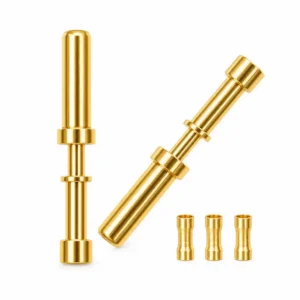
Send the contact drawing and revision, wire datasheet, housing and mating details, proposed tool information and planned quantity. State whether the request is for loose contacts, sample terminations or another agreed supply scope. If dimensions are preliminary, identify them clearly and explain which constraints are already fixed.
For crimp contacts made to a new drawing, a useful enquiry also names the party responsible for each decision. The contact supplier, wire supplier, tooling supplier and assembler may hold different parts of the information. A shared list of open questions helps prevent one party’s assumption from being treated as another party’s approval.
Specify which wire and tool will be used for samples and which assembly questions those samples must resolve. If production will use different equipment or an alternative wire, identify the additional review needed. Detailed acceptance testing can then be agreed for the actual combination, rather than copied from a different contact family.
Use the JC project enquiry to submit this package. The immediate objective is a clear wire, barrel and tooling definition, with the remaining decisions assigned before samples are approved.
Not merely because each wire can enter it. Each proposed combination needs to be supported by the contact and tooling requirements. State the complete intended wire range, including construction and insulation details, so the review can identify what is covered and what remains unverified.
Possibly, if its tooling configuration and instructions support the proposed contact and wire. Supply the tool, die and locating-part references for review. A similar barrel diameter or a matching wire-size marking does not establish a suitable setup on its own.
No. Conductor size is only one input. The contact, termination, mating interface and operating conditions also affect the connection. Provide the electrical and environmental requirements and agree the relevant validation before assigning a rating to the finished assembly.

Choose Jingcheng for one-stop precision connector solutions. Automated production reduces costs, while strict quality control guarantees performance. Enjoy higher precision, faster delivery, and a brand-new cooperative experience with superior cost-performance.